



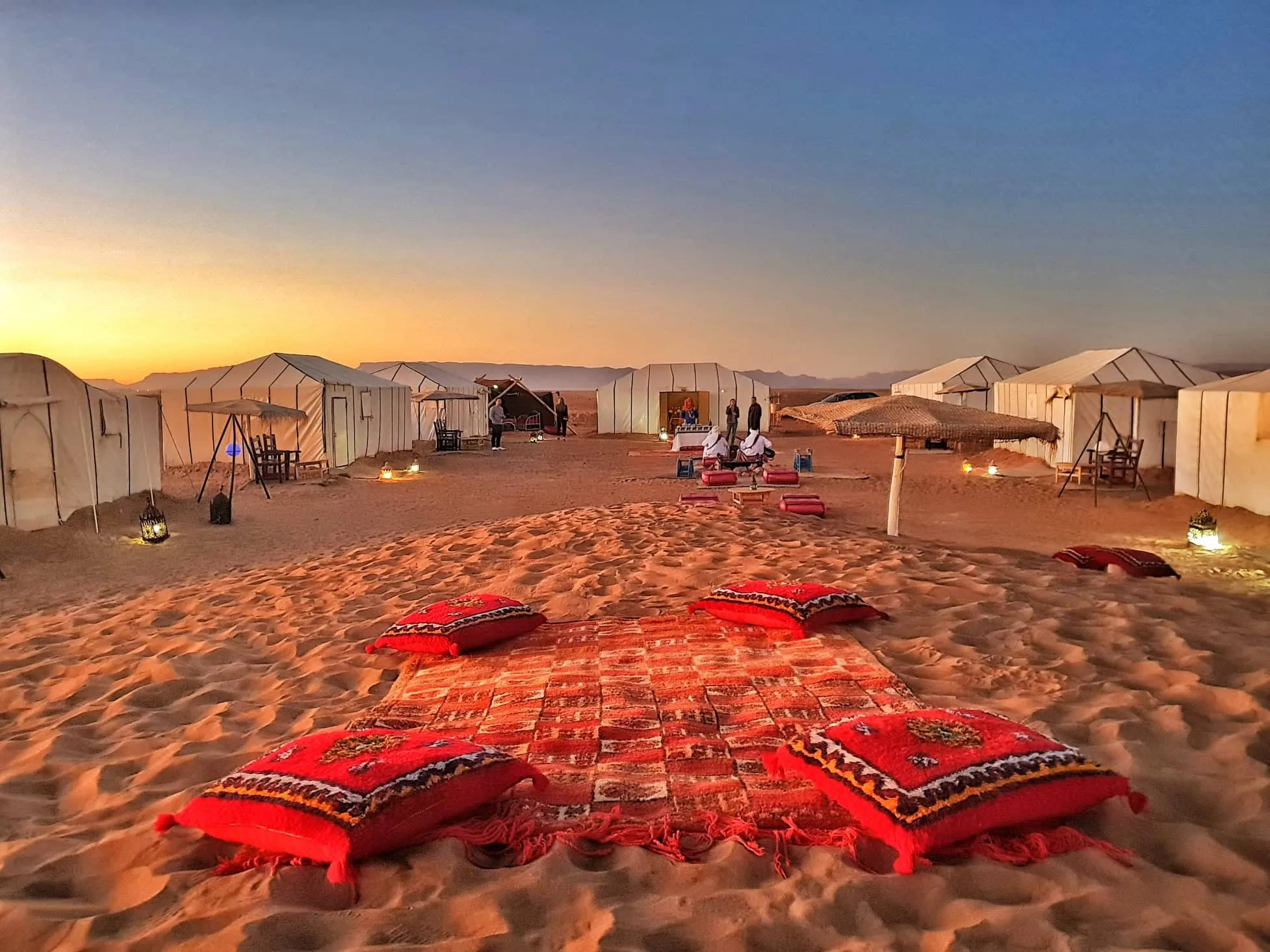
There are places in the world that demand to be experienced in person. The Sahara Desert is chief among them. Stretching across eleven countries and covering more than nine million square kilometres, it is the largest hot desert on the planet and Morocco offers one of the most accessible, dramatically beautiful entry points into it.
But what actually happens on a Sahara Desert tour? What does each day look like? How cold does it get at night? What do you eat, sleep on, and do between the iconic camel ride and the sunrise? This guide answers all of it, honestly and in full.
The Journey There Is Part of the Experience
Most travellers begin in Marrakech or Fez. The overland route south through the High Atlas Mountains, the Drâa Valley, and the ancient kasbahs of the Moroccan south is one of the great road trips of North Africa. You pass juniper-covered mountain slopes, descend through rose-coloured gorges, and roll through palm-fringed oases before the land flattens and begins to turn amber and bare.
Standard stops on the way south include Aït Benhaddou (a UNESCO-listed mud-brick fortress that has appeared in dozens of films), the Todra Gorge (a 300-metre canyon of sheer limestone walls), and the Drâa Valley (one of the world’s longest palm oases). On a multi-day tour, this leg is spread across two days, so you are not just racing through it.
By the time you arrive at the edge of the Erg Chebbi dune sea near Merzouga, the drive itself has already earned its place in your memory. The transition from alpine peaks to open desert, witnessed slowly across hours, is something no flight or summary can deliver.
What the Desert Actually Looks Like
Dunes are real and as spectacular as advertised, but they account for only about 25% of the Sahara’s total area. The rest is a varied landscape of flat rocky plains (hammada), fossilised riverbeds, salt flats, volcanic hills, and oasis villages wherever underground water surfaces. Understanding this variety is part of what makes a desert tour genuinely educational rather than a single-note experience.
The Erg Chebbi dune sea near Merzouga is Morocco’s most iconic dune field, with individual dunes rising to 150 metres. The colour shifts continuously with the light ,pale gold at midday, deep copper in the late afternoon, almost violet in the shadow of sunset. Photographs do not capture the scale. You need to stand inside it.
Activities on a Sahara Desert Tour
Camel Trekking
This is the experience most people picture, and it lives up to it. You ride in a guided caravan across the dunes, typically in the late afternoon as the light turns warm and soft. The pace is slow, the rhythm is hypnotic, and the view from camel-back gives you a sense of scale that no vehicle can match. Most tours offer an hour to two hours of riding to reach the desert camp, with a return ride at dawn.
Sunrise and Sunset from the Dunes
If you do one thing in the Sahara, let it be this. Climb a dune any dune, and watch the sun rise or set over the desert. The colours move through a full spectrum in minutes. Many travellers describe it as the single most vivid visual memory of their entire trip to Morocco.
Sandboarding
The dunes around Erg Chebbi are excellent for sandboarding. Boards are usually provided by camps or local operators. No experience is needed, and the soft sand landing at the bottom makes falls entirely harmless.
Fossil Hunting
The pre-Saharan region of Morocco is one of the richest fossil sites in the world. Ammonites, trilobites, and ancient marine life are embedded in the rock formations across the hammada plains testament to the fact that this landscape was once a seafloor. A knowledgeable local guide can show you specimens that a casual eye would pass straight over.
Village Visits and Cultural Encounters
On longer tours, itineraries often include visits to Berber villages and encounters with semi-nomadic communities on the desert fringe. Sharing tea in a traditional tent, watching traditional weaving, or sitting around a fire listening to Gnawa drumming , these moments are the ones that linger longest after you return home.
Overnight in the Desert
The overnight camp is the emotional centrepiece of any Sahara tour. There is nothing quite like spending a night in the middle of a dune sea under a sky so dense with stars that the Milky Way is visible as a solid band from horizon to horizon.
Desert camps in Morocco range from basic Berber-style tents to well-appointed semi-permanent structures. Most mid-range camps used by quality tour operators offer comfortable tents with proper mattresses and wool blankets, shared bathroom facilities, and a central gathering space.
Evenings at camp follow a natural rhythm: arrival by camel at sunset, welcome tea, dinner (usually a tagine or couscous cooked over fire), and then a fireside session of drumming and storytelling. If you have any interest in astronomy, bring binoculars. The absence of light pollution in the Sahara produces skywatching conditions that can genuinely stop you in your tracks.
Waking before dawn to climb a dune and watch the sun rise is one of the most consistently described transformative experiences in travel. The cold of the pre-dawn hour, the purple-grey light over the sand, and the complete stillness before the heat begins , it is not something you forget.
Berber Culture Along the Way
The Sahara is not empty. It has been home to Amazigh (Berber) communities for thousands of years, and their culture : language, music, architecture, relationship with the landscape , is woven through every part of a desert tour.
The Saharan Berbers of this region are sometimes called the “Blue People,” a reference to the indigo-dyed robes that historically left traces of colour on the skin. Their knowledge of the desert is extraordinary: they navigate by stars, read wind patterns in the dunes, and understand where water lies beneath apparently barren ground. A good local guide carries this knowledge and shares it generously.
Tea is central to Berber hospitality , always offered in three glasses, representing friendship, love, and death. Refusing is considered impolite. Accept, drink slowly, and let the ritual slow your pace. The desert rewards patience.
Desert Weather: Not Just Heat
One of the biggest misconceptions about the Sahara is that it is relentlessly hot. In reality, the temperature swing between midday and midnight can exceed 30°C on a single day. Packing for the desert means packing for extremes in both directions.
Summer (June–August): Daytime temperatures reach 40–45°C. Not recommended for extended outdoor activity. Very quiet, very hot.
Autumn (September–November): Ideal. Days are warm (25–35°C), evenings are cool, and the light is beautifully soft. One of the two peak seasons.
Winter (December–February): Days are pleasant (15–22°C) but nights can drop to near zero. Bring warm layers. Snow on the Atlas Mountains provides a surreal backdrop to the sand.
Spring (March–May): The second peak season. March and April are considered by many guides to be the single best time to visit : warming days, cold nights, spectacular wildflowers in the oases.
The best window overall is October to April, with March and October as the sweet spots.
What to Pack
The fundamental principle of desert packing is layers over bulk, and coverage over exposure. The sun is fierce, the wind carries fine sand into everything, and the nights demand genuine warmth.
Bring lightweight long-sleeved tops and loose trousers for the day, plus a fleece or down jacket for evenings and nights. A wide-brim hat, wraparound sunglasses, and a large desert scarf (shemagh or similar) are essential; the scarf doubles as sun protection, sand shield, and warmth at night. Closed-toe shoes are better than sandals on the dunes and rocky terrain.
Carry at least two litres of water at all times and drink before you feel thirsty , dehydration in the desert sets in faster than most people expect. SPF 50 sunscreen, electrolyte sachets, and basic first-aid supplies are worth the small weight they add to your bag.
Protect your electronics. Fine desert sand destroys lenses, ports, and screens. Use zip-lock bags when riding camels or in windy conditions, and carry spare batteries , cold nights drain them faster than you expect.
How Long Should Your Tour Be?
3 Days : The Efficient Classic
Three days is the most popular option for travellers with limited time who still want a genuine desert experience. You travel south via the Atlas and the Drâa Valley on day one, spend day two in the desert (sunset camel ride, overnight camp, dawn dune climb), and return to Marrakech on day three. Everything essential, nothing rushed as long as you accept that the road south is itself part of the experience.
Best for: First-time visitors to Morocco, travellers on a fixed schedule, anyone who wants the Sahara without sacrificing the rest of their Moroccan itinerary.
👉 View the 3-Day Sahara Desert Tour
5 Days : More Depth, More Discovery
Five days lets the journey breathe. You can linger in the Todra Gorge, spend a morning in the Dades Valley, and arrive at the desert with energy rather than road fatigue. The extra nights in the south allow for a second Sahara experience, perhaps a longer trek into the dunes, or a morning you would have had to skip on a shorter tour. The landscapes between Marrakech and Merzouga are not just a transit corridor; they deserve time.
Best for: Travellers who want to understand southern Morocco as a destination in its own right, not just a means of reaching the sand.
👉 View the 5-Day Sahara Desert Tour
6 Days : The Trekking Immersion
For those who want the desert to get under their skin literally a six-day trekking tour is in a different category entirely. Rather than viewing the dunes from camel-back or vehicle windows, you walk them. You feel the sand shift under your feet, read the wind in the dune faces, and develop the slow, deliberate awareness that desert travel demands. Multi-day treks cover ground that vehicles never reach, delivering solitude and scenery unavailable on shorter tours. Nights are spent in remote camps away from the tourist cluster near Merzouga.
Best for: Active travellers, photographers, anyone seeking a genuine wilderness experience rather than a tour of one.
👉 View the 6-Day Sahara Trekking Tour
Final Thought
The Sahara is one of those places where the gap between expectation and reality closes quickly and then the reality exceeds the expectation. The dunes are as large as you imagined. The stars are brighter. The silence is more complete. And the warmth of the people who call this landscape home will stay with you longer than any photograph.
Whatever time you have, there is a tour that fits it. The only mistake is not going.
If this guide has made you want to book a flight, that’s the point. Atlas Imlil has been taking travellers into the Moroccan Sahara for years : small groups, local guides, no middlemen. Plan your desert trip with us →
FAQ
What is included in a Sahara Desert tour?
Most Sahara Desert tours include transport from Marrakech or Fez, an overland journey through the Atlas Mountains and southern Morocco, a camel ride at sunset, an overnight stay in a desert camp, and a sunrise experience over the dunes. Meals, accommodation, and a local guide are typically included. Optional activities like sandboarding or quad biking may cost extra.
How many days do I need for a Sahara Desert tour?
Three days is the minimum for a meaningful experience , you get the camel ride, the overnight camp, and the sunrise. Five days lets you explore the landscapes of southern Morocco properly. Six days is ideal if you want a trekking experience deep into the dune sea. The right length depends entirely on your time and what kind of trip you are after.
What is the best time of year to visit the Sahara in Morocco?
October to April is the best window for a Sahara Desert tour. March and October are particularly good : days are warm, nights are cool, and the light on the dunes is spectacular. Summer (June–August) is possible but daytime temperatures regularly exceed 40°C, which limits what you can do outdoors.
How cold does the Sahara get at night?
Desert nights are colder than most visitors expect. In winter months (December–February) temperatures can drop to near zero. Even in autumn and spring, nights regularly fall to 8–12°C. Always bring a warm layer regardless of when you travel.
Is a Sahara Desert tour suitable for beginners?
Yes. A standard 3-day or 5-day Sahara Desert tour requires no previous hiking or riding experience. The camel trek to camp is short and guided. A 6-day trekking tour involves more physical activity and is better suited to travellers who are comfortable walking several hours a day.

